
The CRAVE Leadership framework is a neurobehavioral leadership model grounded in five relational leadership behaviors: Communication, Respect, Authenticity, Vulnerability, and Empathy. In contrast to existing models that address these concepts in isolation, CRAVE integrates them into a unified, actionable approach. Rather than serving as a neuroscience model, CRAVE interprets leadership behaviors through established research on psychological safety, social cognition, and socio-affective regulation. The framework highlights how consistent leadership behaviors shape team climates by influencing perceptions of safety, trust, and belonging, thereby supporting learning, engagement, and adaptive performance.
Drawing from psychological safety research, leadership theory, and social neuroscience, the CRAVE framework is advanced as an integrative, practice-oriented model that connects leadership behavior to organizational outcomes through identifiable social and psychological mechanisms. Its distinctiveness lies in translating multiple relational concepts, often addressed separately in other models, into a unified and practical framework. Rather than asserting direct neural causality or biological determinism, CRAVE employs neuroleadership insights as an interpretive lens to explain how leadership behaviors are experienced within social systems. This approach provides leadership scholars and practitioners with a coherent structure for understanding how leadership behavior contributes to sustainable organizational functioning.
This work makes three primary contributions to applied leadership scholarship and practice. First, it introduces CRAVE Leadership as a unified neurobehavioral framework that integrates relational leadership behaviors into a coherent structure, distinct from existing frameworks that often address these behaviors in isolation. By synthesizing Communication, Respect, Authenticity, Vulnerability, and Empathy into a single framework, CRAVE addresses the fragmentation frequently observed in leadership research and offers a practical model that can be applied consistently across organizational contexts. Leadership behavior is central to shaping psychological safety through everyday interpersonal actions (Edmondson, 1999).
Second, this work contributes to the growing neuroleadership literature by demonstrating how neuroscience-informed concepts can be applied responsibly within leadership scholarship. Rather than relying on direct neural claims, the framework aligns leadership behaviors with established research on psychological safety, social threat–reward dynamics, and socio-affective regulation (Rock, 2008). This approach maintains scientific credibility while enhancing the explanatory depth of leadership behavior.
Third, this work advances applied leadership practice by translating abstract leadership constructs into observable behaviors and relational conditions. By linking leadership actions to psychological safety, learning behavior, trust, and engagement, CRAVE provides a practical roadmap for shaping organizational culture and supporting adaptive performance (Sanaia, 2023). Additionally, the framework offers a foundation for future empirical research, leadership development interventions, and practitioner-focused leadership education.
1. Methodological Approach
This article employs a selective integrative synthesis to develop the CRAVE Leadership framework. By synthesizing foundational leadership theories (e.g., Edmondson, 1999; Walumbwa et al., 2008) with contemporary neuroleadership perspectives (Rock, 2008; Lieberman, 2013), this work bridges the gap between abstract relational constructs and observable behaviors. The literature selection focused on peer-reviewed research addressing psychological safety, social threat-reward dynamics, and socio-affective regulation to ensure conceptual rigor while maintaining applied relevance for leadership practitioners.
2. Theoretical Foundations
Psychological Safety and Leadership Behavior
Psychological safety has emerged as a foundational construct in leadership and organizational research, particularly in relation to learning, voice, and collaboration. Psychological safety refers to a shared belief that the team is safe for interpersonal risk-taking, enabling individuals to speak up, ask questions, admit mistakes, and contribute ideas without fear of embarrassment or punishment. (Edmondson, 1999) Research has consistently shown that psychologically safe environments support learning behavior, adaptability, and performance across organizational contexts (Edmondson, 1999).
Leadership behavior plays a central role in shaping psychological safety. Leaders influence team climates through everyday interpersonal actions, including how they communicate expectations, respond to errors, invite participation, and acknowledge contributions. These behaviors signal whether speaking up is welcomed or discouraged, thereby shaping the social norms that govern interaction within teams. Importantly, psychological safety is not a personality trait or a static climate condition; rather, it is dynamically constructed through repeated social interactions over time (Frazier et al., 2017). In applied leadership scholarship, psychological safety serves as an important bridge between leadership behavior and organizational outcomes. It offers a behaviorally grounded explanation of how leadership actions translate into collective learning and engagement, making it particularly relevant to practice-oriented leadership frameworks.
Neuroleadership perspectives have contributed to leadership research by highlighting how individuals experience workplace interactions through social threat and reward dynamics. Rather than positioning neuroscience as a causal explanation, this literature offers an interpretive lens for understanding why certain leadership behaviors are experienced as motivating, stressful, or disengaging. Social contexts that enhance certainty, fairness, belonging, and autonomy are generally experienced as rewarding, whereas environments characterized by ambiguity, exclusion, or inconsistency are more likely to be perceived as threatening (Lieberman, 2013). (The SCARF Model and Conflict, n.d.)
Leadership behaviors influence these perceptions by shaping how individuals interpret interpersonal cues. For example, inconsistent communication may increase uncertainty, dismissive responses may signal diminished status or respect, and a lack of empathy may weaken feelings of belonging. Conversely, transparent communication, respectful treatment, and relational consistency can reduce perceived threat and support engagement.
When applied cautiously, social threat–reward framing helps explain how leadership behaviors are translated into psychological experiences without requiring direct neural measurement. This approach aligns with applied leadership research by emphasizing how leaders shape social environments that either enable or inhibit participation, learning, and collaboration.
Neuroplasticity and Leadership Development
Leadership development scholarship increasingly emphasizes the role of practice, reflection, and experiential learning in shaping leadership capability over time. From a neuroleadership perspective, neuroplasticity broadly refers to the brain’s capacity to adapt to experience. (Agnorelli et al., 2024) While leadership research does not require neuroscientific measurement to validate behavioral change, the concept of neuroplasticity provides a useful theoretical rationale for why leadership behaviors can be developed through intentional practice.
Rather than framing leadership development as the acquisition of fixed traits, neuroplasticity supports a view of leadership as a set of learnable behaviors shaped through repeated social interaction. This perspective aligns with leadership development approaches that emphasize coaching, feedback, and reflective practice. Importantly, neuroplasticity is used here as a conceptual foundation for change, not as a deterministic explanation of leadership effectiveness. To illustrate this, consider the journey of a mid-level manager who once struggled with public speaking and team engagement. Through targeted coaching and consistent practice, they gradually improved their communication skills, ultimately fostering a more inclusive and dynamic team environment. This transformation underscores the potential for leadership growth and development through the application of neuroplastic principles.
Within applied leadership frameworks, neuroplasticity reinforces the idea that consistent leadership behaviors, when practiced over time, can shape individual habits, team norms, and organizational culture. This perspective supports the positioning of leadership models as developmental systems rather than prescriptive toolkits.
3. The CRAVE Neurobehavioral Leadership Framework
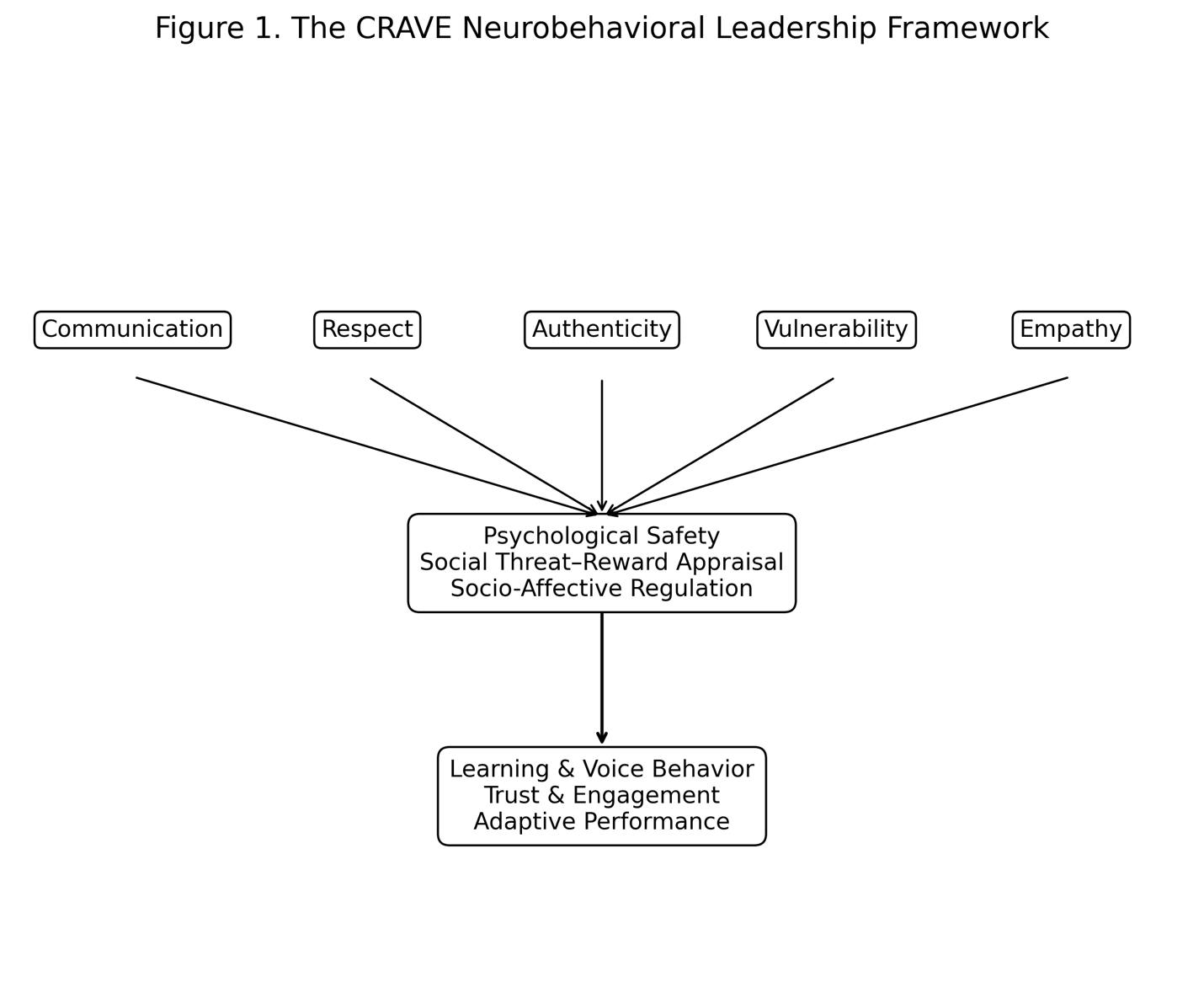
This figure presents CRAVE Leadership as a neurobehavioral framework that links observable leadership behaviors (Communication, Respect, Authenticity, Vulnerability, and Empathy) to relational and psychological mechanisms, including psychological safety, social threat–reward appraisal, and socio-affective regulation. These mechanisms support individual and collective outcomes such as learning behavior, trust, engagement, and adaptive performance. The framework is interpretive rather than causal and positions neuroleadership insights as explanatory lenses aligned with established leadership and organizational research.
4 CRAVE Pillars as Neurobehavioral Leadership Mechanisms
4.1 Communication as a Neurobehavioral Leadership Mechanism
Communication and Leadership
Communication is a foundational leadership behavior that shapes how information, expectations, and meaning are constructed within teams. Leadership communication extends beyond the transmission of information to include how leaders listen, respond, clarify, and engage in dialogue. Through these behaviors, leaders influence not only task coordination but also how individuals interpret their roles, values, and levels of inclusion within the group (Dirks & Ferrin, 2002).
In applied leadership contexts, communication functions as a primary mechanism through which leaders establish norms for interaction. Clear, consistent, and inclusive communication supports alignment and reduces ambiguity, whereas inconsistent or opaque communication can increase uncertainty and disengagement. As such, communication serves as a critical behavioral lever for shaping team climate and relational dynamics.
Communication and Psychological Safety
Leadership communication plays a central role in fostering psychological safety by signaling whether participation and voice are encouraged. When leaders invite input, acknowledge questions, and respond constructively to feedback or mistakes, they reinforce norms that support interpersonal risk-taking. These behaviors reduce fear of negative evaluation and encourage individuals to contribute ideas, concerns, and alternative perspectives (Edmondson, 1999).
Conversely, dismissive responses, lack of follow-up, or inconsistent messaging may inhibit voice by increasing uncertainty or perceived interpersonal risk. Over time, these patterns influence whether teams engage in open dialogue or default to silence. From a psychological safety perspective, communication is therefore not neutral; it actively shapes the conditions under which learning and collaboration occur.
Communication Through a Neuroleadership Lens
From a neuroleadership perspective, communication behaviors can be interpreted through social threat–reward dynamics related to certainty and relatedness. Clear communication reduces ambiguity, which may lower perceived threat, while responsive listening supports social connection and belonging. Importantly, this interpretive lens does not imply direct neural causation but offers a conceptual explanation for why certain communication behaviors are experienced as stabilizing or destabilizing within social systems.
By framing communication as a neurobehavioral mechanism, leadership behaviors are understood as shaping how individuals experience safety, predictability, and inclusion. This framing enhances explanatory depth while remaining consistent with applied leadership research and avoiding neuroscientific overreach.
Communication and Leadership Outcomes
Through its influence on psychological safety and social meaning, leadership communication supports outcomes such as learning behavior, trust, engagement, and adaptive performance. Teams characterized by open and consistent communication are more likely to engage in problem-solving, knowledge sharing, and constructive conflict. Over time, these behaviors contribute to organizational resilience and sustained effectiveness.
Within the CRAVE Leadership framework, communication functions as a foundational behavior that enables the other relational pillars to operate effectively (Sanaia, 2023). Without clear and inclusive communication, respect may not be perceived, authenticity may be misinterpreted, vulnerability may feel unsafe, and empathy may not be expressed or received as intended.
4.2 Respect as a Neurobehavioral Leadership Mechanism
Respect and Leadership
Respect in leadership is expressed through behaviors that communicate dignity, fairness, and recognition of others’ contributions. Rather than functioning as a personal attitude or value statement, respect is enacted through consistent interpersonal actions, including equitable treatment, acknowledgment of perspectives, and consideration of how decisions affect others. In leadership contexts, respect establishes the social conditions under which individuals feel valued and included within the group.
From an applied leadership perspective, respect operates as a relational signal that shapes identity and belonging (Dirks & Ferrin, 2002). Leaders who demonstrate respect through their actions reinforce norms of inclusion and mutual regard, whereas inconsistent or dismissive behaviors may undermine trust and cooperation. As such, respect is a behavioral condition that influences whether individuals perceive the organization as fair and psychologically safe.
Respect and Psychological Safety
Respect directly contributes to psychological safety by reducing concerns about social status and exclusion. When individuals experience respectful treatment, they are more likely to believe that their contributions will be considered without negative personal consequences. This perception supports interpersonal risk-taking, including speaking up, offering dissenting views, and admitting uncertainty.
In contrast, environments marked by disrespect, whether overt or subtle, may heighten perceived social threat, discouraging voice and participation. Over time, patterns of respectful or disrespectful leadership behavior shape shared norms about who is heard, whose input matters, and whether collaboration is genuinely encouraged. Respect, therefore, serves as a stabilizing condition for psychologically safe team climates.
Respect Through a Neuroleadership Lens
Through a neuroleadership lens, respect can be understood in terms of social threat–reward dynamics associated with fairness and belonging. Fair and inclusive treatment is generally experienced as socially rewarding, whereas perceived disrespect may activate threat responses related to exclusion or diminished status. Importantly, this interpretation does not assert biological causation but provides a conceptual explanation for why respectful leadership behaviors support engagement and cooperation.
By framing respect as a neurobehavioral mechanism, leadership behaviors are understood to shape how individuals experience inclusion and relational safety within social systems. These framings complement organizational justice and leadership research by providing an explanatory bridge between interpersonal behavior and collective outcomes.
Respect and Leadership Outcomes
Leadership respect supports outcomes such as trust, engagement, collaboration, and retention by reinforcing a shared sense of fairness and inclusion. Teams characterized by respectful interaction are more likely to sustain cooperation, navigate conflict constructively, and maintain commitment to collective goals. Within the CRAVE Leadership framework, respect functions as a relational anchor that strengthens the effectiveness of other leadership behaviors.
4.3 Authenticity as a Neurobehavioral Leadership Mechanism
Authenticity and Leadership
Authenticity in leadership refers to the alignment between a leader’s values, intentions, and actions, as expressed through consistent, transparent behavior. Authentic leadership is not defined by self-disclosure alone, but by coherence between what leaders say, how they behave, and how they make decisions. This coherence reduces ambiguity and supports credibility in leader–follower relationships (Walumbwa et al., 2008).
In applied leadership contexts, authenticity provides clarity about a leader’s intent. When leaders behave authentically, individuals are better able to interpret decisions and actions without excessive attributional uncertainty. This clarity supports trust formation and relational stability within teams.
Authenticity and Psychological Safety
Authenticity contributes to psychological safety by reducing uncertainty about leaders’ motives and expectations. Transparent communication, acknowledgment of limitations, and consistency between stated values and behavior help individuals anticipate responses and navigate interpersonal interactions with greater confidence. As a result, team members may feel more comfortable raising concerns, offering feedback, and engaging in open dialogue. When authenticity is absent, individuals may experience increased ambiguity regarding expectations or consequences, which can inhibit participation and voice. Over time, authentic leadership behaviors shape team climates by signaling whether openness and honesty are supported or discouraged (Dirks & Ferrin, 2002).
Authenticity Through a Neuroleadership Lens
From a neuroleadership perspective, authenticity can be interpreted as supporting predictability and trust within social systems. Coherent leadership behavior may reduce perceived social threat by aligning signals related to intent and reliability. This interpretive lens does not imply neural determinism but offers a conceptual explanation for why authentic leadership behaviors are experienced as stabilizing and trust-enhancing. By framing authenticity as a neurobehavioral mechanism, leadership behaviors are understood to shape how individuals interpret leader credibility and relational consistency. This framing strengthens theoretical integration while remaining consistent with applied leadership scholarship.
Authenticity and Leadership Outcomes
Authentic leadership supports outcomes such as trust, engagement, and ethical climate by reinforcing clarity and credibility in leader–follower relationships. Within the CRAVE framework, authenticity functions as a trust-calibrating behavior that enhances the effectiveness of communication, vulnerability, and empathy by reducing ambiguity and reinforcing relational coherence.
4.4 Vulnerability as a Neurobehavioral Leadership Mechanism
Vulnerability and Leadership
Vulnerability in leadership involves the willingness to acknowledge uncertainty, admit mistakes, and invite input without relinquishing responsibility or authority. (The Power of Vulnerability in Leadership, 2024) When appropriately enacted, vulnerability signals openness and a learning orientation rather than weakness. In leadership contexts, vulnerability is expressed through behaviors that normalize uncertainty and model adaptive responses to challenge (Dirks & Ferrin, 2002). From an applied leadership perspective, vulnerability serves as a social signal that reframes errors and uncertainty as opportunities for learning. This reframing influences whether teams respond to challenges with defensiveness or curiosity.
Vulnerability and Psychological Safety
Leader vulnerability plays a critical role in fostering psychological safety by legitimizing interpersonal risk-taking. When leaders openly acknowledge limitations or mistakes, they reduce fear associated with error and imperfection. This behavior signals that learning and improvement are valued over blame, encouraging team members to speak up and experiment.
However, vulnerability is most effective when paired with accountability and clear expectations. Without structure, vulnerability may create ambiguity rather than safety. When enacted within a learning-oriented environment, vulnerability strengthens norms of openness and continuous improvement.
Vulnerability Through a Neuroleadership Lens
From a neuroleadership perspective, vulnerability can be interpreted as reducing social threat by signaling acceptance of imperfection and uncertainty. By modeling non-defensive responses, leaders may help regulate collective emotional responses to risk and failure. This interpretation emphasizes social regulation rather than biological causation (Edmondson, 1999). By framing vulnerability as a neurobehavioral mechanism, leadership behaviors are understood to shape how teams experience uncertainty and respond to challenges. This framing supports integration with learning and adaptive leadership research.
Vulnerability and Leadership Outcomes
Vulnerability supports outcomes such as learning, innovation, and adaptive performance by creating conditions that encourage experimentation and feedback. Within the CRAVE framework, vulnerability functions as a catalyst for learning, strengthening psychological safety, and reinforcing the developmental orientation of leadership practice.
4.5 Empathy as a Neurobehavioral Leadership Mechanism
Empathy and Leadership
Empathy in leadership is the capacity to recognize, understand, and appropriately respond to others’ emotions and perspectives. (Taplin, 2023) Effective leadership empathy is not synonymous with emotional absorption, but rather with calibrated perspective-taking that informs decision-making and relational engagement. Empathy enables leaders to respond proportionately to social cues while maintaining role clarity. In applied leadership contexts, empathy supports relational attunement by helping leaders understand how others experience decisions and behaviors. This capacity enhances communication, conflict management, and trust (Decety & Jackson, 2004).
Empathy and Psychological Safety
Empathetic leadership contributes to psychological safety by signaling care and consideration for individual experiences. When leaders demonstrate understanding and responsiveness, individuals are more likely to feel seen and supported, reducing fear of negative interpersonal consequences. This perception supports openness, dialogue, and collaboration. Conversely, a lack of empathy may lead individuals to withhold concerns or disengage emotionally, weakening team cohesion. Empathy, therefore, functions as a relational stabilizer that supports inclusive participation.
Empathy Through a Neuroleadership Lens
Through a neuroleadership lens, empathy can be interpreted as a socio-affective regulatory capacity that supports attunement and relational balance. This perspective emphasizes empathy as a functional leadership skill that can be developed through practice rather than an innate trait. Importantly, this framing avoids reducing empathy to neural activation and instead focuses on its role in social regulation. By framing empathy as a neurobehavioral mechanism, leadership behaviors are understood to shape emotional climates and interpersonal responsiveness within teams.
Empathy and Leadership Outcomes
Empathy supports outcomes such as trust, engagement, and relational resilience by fostering understanding and connection. Within the CRAVE Leadership framework, empathy enhances the effectiveness of communication, respect, authenticity, and vulnerability by ensuring that leadership behaviors are received as intended and aligned with the needs of individuals and teams.
5. An Integrative Neurobehavioral Leadership Framework
The CRAVE Leadership framework integrates five relational leadership behaviors: Communication, Respect, Authenticity, Vulnerability, and Empathy into a coherent neurobehavioral model that explains how leadership actions shape relational and psychological conditions within teams (Sanaia, 2023). As illustrated in Figure 1, CRAVE positions observable leadership behaviors as the primary drivers of social environments that influence psychological safety, social threat–reward appraisal, and socio-affective regulation. These mechanisms, in turn, support key individual and collective outcomes, including learning behavior, trust, engagement, and adaptive performance.
Rather than treating the CRAVE pillars as independent competencies, the framework conceptualizes them as interdependent behavioral signals that operate collectively to shape how leadership is experienced within social systems. Communication provides clarity and reduces uncertainty; respect signals inclusion and fairness; authenticity establishes coherence and credibility; vulnerability legitimizes learning and interpersonal risk-taking; and empathy supports attunement and proportionate response. When enacted consistently, these behaviors reinforce one another, creating relational conditions that support psychological safety and sustained engagement (Dirks & Ferrin, 2002).
Figure 1 depicts this integrative process by organizing CRAVE behaviors at the level of observable leadership actions, distinct from but linked to relational and psychological mechanisms. Psychological safety serves as a central mediating condition through which leadership behaviors influence learning and voice behavior. Social threat–reward appraisal provides an interpretive lens for understanding how leadership actions are experienced as either stabilizing or destabilizing, particularly in relation to certainty, fairness, and belonging. Socio-affective regulation captures how leadership behaviors shape emotional climates and interpersonal responsiveness within teams.
Importantly, the framework is interpretive rather than causal. CRAVE does not assume direct neural activation or deterministic biological processes. Instead, it aligns leadership behaviors with established research on social cognition and psychological safety to explain how leadership actions are translated into shared experiences of safety, trust, and engagement. This positioning allows the framework to incorporate neuroleadership insights while remaining consistent with applied leadership scholarship and methodological rigor.
The integrative nature of CRAVE also highlights the importance of behavioral consistency. Isolated demonstrations of communication, respect, or empathy are unlikely to produce sustained outcomes if other leadership behaviors undermine relational coherence. For example, transparent communication may lose credibility without authenticity, and vulnerability may not support learning if respect and psychological safety are lacking. Figure 1 emphasizes that leadership effectiveness emerges from the patterned interaction of behaviors, not from any single pillar in isolation.
Through this integrative structure, CRAVE offers a practical yet theoretically grounded explanation of how leadership behavior shapes organizational culture and performance. By connecting observable leadership actions to relational mechanisms and outcomes, the framework provides a clear pathway for leadership development, empirical testing, and applied practice. As such, CRAVE contributes a cohesive model for understanding leadership as a neurobehavioral system embedded within social contexts.
5.1 Differentiating CRAVE from Adjacent Theories
To clarify the unique contribution of CRAVE Leadership, it is necessary to differentiate it from established frameworks. While Transformational Leadership emphasizes visionary inspiration and individualized consideration (Bass & Riggio, 2006), CRAVE focuses specifically on the neurobehavioral mechanisms that sustain the relational climate. Unlike Authentic Leadership, which emphasizes the leader’s internal self-awareness and moral perspective (Walumbwa et al., 2008), CRAVE prioritizes the interpersonal signaling of behaviors (Communication, Respect, Authenticity, Vulnerability, Empathy) and their impact on the follower’s perception of safety. Finally, while the SCARF model identifies five domains of social experience (Status, Certainty, Autonomy, Relatedness, Fairness) as primary rewards or threats (Rock, 2008), CRAVE serves as the behavioral delivery system for these domains. CRAVE translates the “what” of social needs (SCARF) into the “how” of daily leadership action.
6. Limitations and Boundary Conditions
While the CRAVE framework offers an integrative approach to leadership, it is subject to several limitations. First, as a conceptual framework, the proposed relationships between CRAVE behaviors and psychological safety have not yet been empirically tested through quantitative or longitudinal research. Second, the framework assumes a degree of behavioral plasticity that may be constrained by deep-seated personality traits or rigid organizational cultures. Third, although CRAVE incorporates neuroleadership insights, it relies on an interpretive lens rather than direct neuroscientific measurement; therefore, it does not claim biological determinism. Finally, cultural and contextual variations may influence how behaviors like “vulnerability” or “authenticity” are perceived. Leaders must adapt the framework to the specific norms of their professional and cultural environments to avoid relational misalignment.
7. Practical Implications for Leadership Practice
The CRAVE Leadership framework offers several implications for applied leadership practice, particularly in leadership development, organizational culture, and team effectiveness. By translating abstract leadership constructs into observable behaviors, CRAVE provides leaders with a practical structure for shaping relational environments that support learning, engagement, and adaptability (Edmondson, 1999).
First, CRAVE emphasizes behavioral consistency as a core leadership practice. Leaders seeking to foster psychological safety and trust must attend not only to what they intend, but to how their behaviors are experienced over time. Communication clarity, respectful treatment, authentic decision-making, appropriate vulnerability, and empathetic responsiveness function collectively to shape relational climates. Leadership development efforts may therefore benefit from focusing on behavioral patterns rather than isolated competencies.
Second, the framework highlights the importance of psychological safety as a leadership outcome, rather than a standalone initiative. CRAVE reframes psychological safety as an emergent condition shaped by leadership behavior, positioning leaders as primary architects of team climates. This perspective shifts leadership practice away from abstract cultural aspirations toward concrete interpersonal actions that influence participation, learning, and voice.
Third, CRAVE supports leadership development approaches grounded in practice, reflection, and feedback. Because the framework conceptualizes leadership behaviors as learnable and adaptable, it aligns with coaching-based and experiential learning models. Leaders can use the CRAVE pillars as reflective anchors to assess how their behaviors contribute to or undermine relational safety and engagement in real-time interactions.
Finally, the framework offers organizations a shared language for leadership behavior. By naming and organizing relational behaviors, CRAVE facilitates dialogue about leadership expectations, development priorities, and cultural norms. This shared language can support alignment across leadership levels and provide a foundation for leadership education, performance development, and organizational learning initiatives.
Together, these practical implications position CRAVE Leadership as a usable, theory-informed framework that bridges leadership scholarship and day-to-day leadership practice. By linking observable behaviors to relational conditions and outcomes, the framework helps leaders intentionally shape environments where individuals and teams can learn, engage, and perform effectively.
8. Future Research Agenda
The CRAVE Leadership framework offers multiple avenues for future research that can extend its conceptual foundation and empirically examine its proposed relationships. As a neurobehavioral leadership model grounded in observable behaviors and relational mechanisms, CRAVE is well-suited for research designs that explore leadership development, team dynamics, and organizational culture without requiring neuroscientific measurement (Edmondson, 1999).
First, future studies may examine the relationship between CRAVE leadership behaviors and psychological safety using survey-based and multilevel research designs. Psychological safety may be tested as a mediating mechanism linking leadership behavior to outcomes such as learning behavior, voice, engagement, and performance. Longitudinal studies would be particularly valuable in assessing how consistent enactment of CRAVE behaviors over time contributes to changes in team climate and relational trust.
Second, experimental and intervention-based research designs offer opportunities to test the developmental assumptions of the framework. Leadership development programs grounded in the CRAVE pillars could be evaluated to assess changes in leadership behavior, psychological safety, and team outcomes. Such studies would contribute to leadership development scholarship by examining whether intentional practice and reflection lead to sustained behavioral change, consistent with the framework’s neurobehavioral orientation.
Third, future research may explore contextual and boundary conditions that shape the effectiveness of CRAVE Leadership. Cultural norms, organizational structures, and professional domains may influence how leadership behaviors are interpreted and enacted. Comparative studies across industries, cultures, or leadership levels could provide insight into how respect, vulnerability, and empathy function differently in different contexts.
Fourth, CRAVE offers a foundation for research examining the interaction among leadership behaviors. Rather than treating leadership behaviors as independent predictors, future studies may investigate how combinations or patterns of CRAVE behaviors influence relational coherence and outcomes. Configurational or systems-based approaches could help identify whether certain behavioral patterns are more strongly associated with psychological safety and engagement than others.
Finally, future research may integrate CRAVE with established leadership theories and constructs, including transformational leadership, authentic leadership, and emotional intelligence (Sanaia, 2023). Such research could examine convergent and discriminant validity, clarifying how CRAVE complements existing frameworks while offering distinct explanatory value. Over time, this line of inquiry may contribute to a more integrated understanding of relational leadership grounded in both theory and practice.
Together, these research directions position CRAVE Leadership as a generative framework that supports sustained scholarly inquiry. By encouraging empirical testing, contextual exploration, and theoretical integration, future research can refine and extend the framework while strengthening its contribution to applied leadership scholarship.
Conclusion
This paper introduced CRAVE Leadership as a neurobehavioral framework that integrates relational leadership behaviors with insights from psychological safety and neuroleadership scholarship. By organizing Communication, Respect, Authenticity, Vulnerability, and Empathy into a coherent model, the framework addresses a persistent gap between leadership theory and practice: how everyday leadership behaviors shape relational conditions that support learning, trust, engagement, and adaptive performance.
CRAVE contributes to applied leadership scholarship by translating abstract constructs into observable behaviors and relational mechanisms. Rather than advancing new traits or prescriptive techniques, the framework emphasizes patterned leadership behavior and relational consistency as drivers of organizational climate. By positioning neuroleadership insights as interpretive lenses rather than causal claims, CRAVE maintains conceptual rigor while enhancing explanatory depth.
For leadership practice, the framework offers a practical structure for reflection, development, and culture shaping. Leaders and organizations can use CRAVE to assess how leadership behaviors are experienced within teams and to intentionally cultivate environments characterized by psychological safety and engagement. For researchers, CRAVE provides a generative foundation for empirical study, leadership development interventions, and theoretical integration across leadership traditions. Taken together, CRAVE Leadership advances a disciplined yet accessible approach to understanding leadership as a neurobehavioral system embedded within social contexts. By connecting leadership behavior to relational conditions and outcomes, the framework offers a pathway for aligning leadership scholarship with the lived realities of organizational leadership. Disclosure: Grammarly (2026) was utilized by the author for technical formatting, citation auditing, and grammatical refinement.
Disclosure Statement
Grammarly was used by the author for formatting, citations, and sentence structure (Grammarly, 2026).
References:
Agnorelli, C., Spriggs, M., Godfrey, K., Sawicka, G., Bohl, B., Douglass, H., Fagiolini, A., Parastoo, H., Carhart-Harris, R., Nutt, D., & Erritzoe, D. (2024). Neuroplasticity and psychedelics: A comprehensive examination of classic and non-classic compounds in pre and clinical models. arXiv preprint. https://doi.org/10.48550/arXiv.2411.19840
Bass, B. M., & Riggio, R. E. (2006). Transformational leadership (2nd ed.). Psychology Press.
Brown, B. (2018). Dare to lead: Brave work. Tough conversations. Whole hearts. Random House.
Cacioppo, J. T., & Cacioppo, S. (2014). Social relationships and health. Physiology & Behavior, 130, 1–7. https://doi.org/10.1016/j.physbeh.2014.02.032
Carmeli, A., Reiter-Palmon, R., & Ziv, E. (2010). Inclusive leadership and employee involvement in creative tasks in the workplace: The mediating role of psychological safety. The Leadership Quarterly, 21(3), 373–387.
Decety, J., & Jackson, P. L. (2004). The functional architecture of human empathy. Behavioral and Cognitive Neuroscience Reviews, 3(2), 71–100.
Dirks, K. T., & Ferrin, D. L. (2002). Trust in leadership: Meta-analytic findings and implications for research and practice. Journal of Applied Psychology, 87(4), 611–628.
Edmondson, A. C. (1999). Psychological safety and learning behavior in work teams. Administrative Science Quarterly, 44(2), 350–383.
Edmondson, A. C. (2018). The fearless organization: Creating psychological safety in the workplace for learning, innovation, and growth. Wiley.
Frazier, M. L., Fainshmidt, S., Klinger, R. L., Pezeshkan, A., & Vracheva, V. (2017). Psychological safety: A meta-analytic review and extension. Personnel Psychology, 70(1), 113–165.
Grammarly. (2026). Grammarly (Version 1.2) [Computer software]. https://www.grammarly.com/
Lieberman, M. D. (2013). Social: Why our brains are wired to connect. Crown.
Rock, D. (2008). SCARF: A brain-based model for collaborating with and influencing others. NeuroLeadership Journal, 1(1), 44–52.
Sanaia, A. (2023). Empower your leadership: Communication and the C.R.A.V.E. method. Amazon.
Walumbwa, F. O., Avolio, B. J., Gardner, W. L., Wernsing, T. S., & Peterson, S. J. (2008). Authentic leadership: Development and validation of a theory-based measure. Journal of Management, 34(1), 89–126.