
“Know your audience” is the mantra of successful communication. To know the audience is to be able to craft a message in such a way that it will not only be heard, but accepted. Leaders must also know their audience, shaping and forming their approach based on the followers. However, often their audience is comprised of individuals, groups, and entire organizations. This research synthesis explores the complexity of multi-level leadership and offers guidance for navigating the approach to produce engaging leadership at every level.
Elements of Organizations
Individual, group, and organizational factors are interconnected and jointly influence performance. While each can be examined in isolation, a holistic approach is necessary to lead effectively, considering the complex interplay of personality, group structures, needs, and organizational systems (Abdillah et al., 2024; Hakiki et al., 2023). Bryant (2003) generically categorized the three groups in relation to their knowledge. Knowledge creation via intellectual stimulation, inspiration, and individualized consideration was related to actions at the individual level. At the group level, knowledge sharing was expressed through a shared vision and mutual encouragement. Knowledge exploitation was found at the organizational level via systems, structures, and routinization.
Later work by Hakiki et al. (2023) expanded on the characteristics of the three elements. The main factors identified in their work are found in Table 1. The framework developed by Hakiki et al. offers a foundation on which to conceptualize and enact the role leadership plays in each of the organizational elements
Table 1
Three Elements of an Organization (Hakiki et al., 2023)
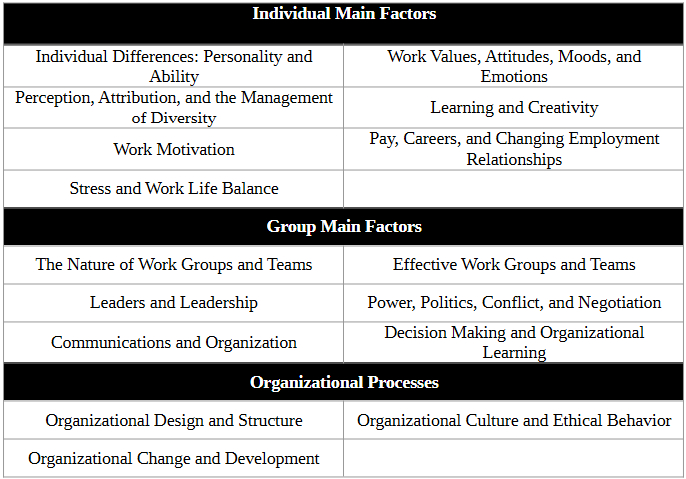
Note. Table adapted from Individual, group dynamics, and organizational processes in the workplace: Factors for better performance and organizational success, by Hakiki, M. S., Anggraini, D. A., Fahmi, N. F., Putra, R. S., & Adinugroho, M., 2023, Journal on Education
Individual Level Leadership
Building on the notion that leadership is defined as influence over others, the discussion of leadership on the individual level must start with how an individual within an organization is influenced. Not all leadership actions have an impact on all the factors identified by Hakiki. For example, a manager offering an employee the opportunity to work on a task force for a new marketing campaign may be tapping into the individual’s unique abilities, creativity, and perhaps even work motivation. Stress and pay may be unaffected. The key is that, while the marketing campaign may have an impact on the whole organization, the leadership of the individual is influencing them to action on a personal level.
Two positions of individual influence can be observed. The first is the impact of leadership on a follower. From this perspective, numerous theories can be applied. For example, authentic leadership is positively related to work engagement, especially when employees have high intrinsic motivation, whereas authoritarian leadership is negatively related to work engagement (Shu, 2015). Transformational leadership is positively associated with followers’ mastery goals, while transactional leadership is positively associated with followers’ performance goals (Hamstra et al., 2014).
The other position from which to observe the impacts of leadership on the individual is that of the individual’s own leadership development. The first question to address is whether leaders are born or made. If born, the impact of leadership on the emerging development of individuals would be irrelevant. If, however, they are made, the question at hand becomes increasingly important. Boerma et al. (2017) presented both sides of the argument. If leaders are born, their traits have a substantial genetic basis, supported by twin studies and personality research; certain core traits (e.g., humility) are innate and necessary for outstanding leadership. If, however, they are made, leadership emerges primarily through deliberate practice, life experiences, and formal development. Their research concluded that about 30% of leadership role occupancy can be attributed to genetic factors, leaving 70% to environmental influences. Afrianty (2020) concluded that leadership development requires both harnessing inherent traits and engaging in continuous learning and ethical growth.
Judge et al. (2002) offered empirical evidence to back the argument of innate leadership abilities. Building upon the Big Five (Goldberg, 1990), Judge et al. (2002) found that extraversion (ρ = .31) was the strongest predictor of leadership, followed by conscientiousness (ρ = .28), and openness to experience (ρ = .24). Mumford et al. (2000; 2007) supported the idea that leadership was grounded in the developing and training of necessary skills. Whether by nature or nurture, whether as a follower or a developing leader, individuals can benefit from the leadership efforts of the organization.
Different approaches to leadership will have varying end results for individuals. Andersen (2018) and Parolini et al. (2009) argued that Greenleaf’s (1977) theory of servant leadership is primarily focused on the development and achievement of the individual rather than the organization. Banks et al. (2016), in their comparison of transformation and authentic leadership styles, found that transformation produced a greater predictive weight for individual-level outcomes.
The focus of individual over organization does not discount the impact that more organization-focused approaches can have on the individual. The development of self-awareness, self-regulation, and clarity of purpose, core attributes to authentic leadership, can lead to an individual’s change-oriented behaviors and internal growth (Halliwell et al., 2023). Authentic leaders who model and encourage a strong leader identity (self-efficacy, reputation, and prototypicality), humility, which creates a safe environment for vulnerability, and spiritual maturity (self-transcendence, self-disclosure, and self-sacrifice), which provide individuals with a guiding moral compass and motivation (Klenke, 2007; Owens & Hekman, 2012). Even transactional leadership can offer individuals clarity and accountability (Lee et al., 2023).
The development of individuals is key to any organization. The success of the individual becomes the building blocks for stronger, healthier, and more efficient groups and teams. Individuals equipped with self-awareness and motivation can offer unique contributions to the organization’s larger effort.
Group/Team Level Leadership
The influence of leadership extends beyond the individual. Groups and teams can be influenced by commonality. Like the two perspectives on individuals – followers and leader development – Burke et al. (2006) identified two approaches to team leadership: task-focused and person-focused. Task-focused leaders clarify direction, structure tasks, and manage resources, while person-focused leaders coach, empower, and build teams. Both approaches, according to Burke et al. (2006), correlate with team performance outcomes, and both are needed for teams to be effective.
This idea of person and task focus comes together to encapsulate the objective of group leadership. When Northouse (2021) defined leadership, he said it was influence over a group of individuals. While the group appears to be moving towards a common outcome, its core remains a series of individuals working together. An American football team is comprised of eleven individuals on the field, driving towards a common goal, yet each moving in different ways, performing various functions.
In a similar approach, the Belbin Team Role Model identifies nine key team roles: Implementer, Coordinator, Shaper, Innovator, Resource Investigator, Monitor Evaluator, Team Worker, Completer Finisher, and Specialist (Belbin, 1981, 2017). Each role is associated with specific strengths, contributions, and allowable weaknesses, and recognizing primary, secondary, and tertiary roles enables individuals to better align with team tasks and dynamics (Townend, 2010). A balance of personality types within the group also contributes significantly to team effectiveness (Bradley & Hebert, 1997).
Once roles are identified, leaders of groups must then work to move the group forward in unity. Salas et al. (2005) offered a framework for group leadership named “The Big Five.” They stated that there are five components of teamwork – team leadership, mutual performance monitoring, backup behavior, adaptability, and team orientation – and that effective teamwork requires these Big Five core components regardless of team type or task.
With the people in place, the roles assigned, and the components present, the process of leadership and group development begins to take shape. Tuckman (1965) offered a significant contribution to the understanding of group development. His original work offered four stages of development: forming, storming, norming, performing, and a subsequent publication added adjourning as the fifth and final stage (Tuckman & Jensen, 1977). The progression of the group development has been debated in the literature. While Wheelan et al. (2003) found empirical support for linear, stage-based models of group development in naturalistic work settings, Miller (2003) found that the development of teams was not strictly linear but that teams sometimes regressed or cycled through earlier stages. Either way, teams have shown to progress, demonstrating in later stages significantly more team learning behaviors, psychological safety, and group potency (Edmondson, 1999; Raes et al., 2015).
The complexity of group dynamics can impact group leadership. Bachiochi et al. (2000) identified twenty qualities of effective team leaders, organized into six related categories. Task-oriented skills and interpersonal skills made up 53% of the effective traits, followed by expertise, communication, personal characteristics, and liaison skills. Balliet and Van Lange (2013) found that larger groups had higher levels of trust and cooperation. In contrast, Wheelan (2009) found that larger groups exhibited more dependency, conflict, and lower perceived trust, structure, and work focus.
The idea of trust in groups is a recurring and popular topic of study. This conflicting research on trust in groups relative to size reflects a larger approach to the understanding of trust in teams. Dumitru and Mittelstadt (2020) offered a review of the various studies, concluding that trust is dynamic and highly context-dependent. Lee et al. (2023) noted that leaders who prioritize fostering an emotional relationship with their employees based on trust, friendship, partnership, support, and guidance create an environment where conflict is less likely to occur. A loss of trust within a group, especially due to despotic leaders, can have a devastating effect, diverting energy away from productive tasks to coping with stressors (Jabeen & Rahim, 2021).
Both transformational and authentic leadership have demonstrated an increase in trust among followers. Authentic leaders act as role models, creating trust, transparency, and supportive environments that help employees align work and personal life demands (Braun & Peus, 2018). The empathy and emotion often displayed as part of authentic leadership enable leaders to form emotional bonds, create trust and cooperation, thus fostering group cohesion and affective climates (Kellett et al., 2006). Similarly, transformational leadership is positively associated with empowerment through social identification with a group (Kark et al., 2003). Transformational leaders create an atmosphere of trust, motivating followers to go beyond their own self-interests (Korejan & Shahbazi, 2016).
Organizational Level Leadership
The processes at the organizational level center around systems, structures, and cultural behavior, exploiting the knowledge developed at the individual and group levels (Bryant, 2003; Hakiki et al., 2023). The complexity of group dynamics intensifies when raised to the level of an organization, requiring an even more intentional and systematic approach to leadership.
There is no conclusive agreement on the number of leadership theories that can be applied to organizations. Instead, leaders are offered a menu of approaches from which they can choose to apply to their given environment. Nanjundeswaraswamy et al. (2024) noted that the sheer amount of leadership theories and styles published over the decades demonstrates the complexity of the subject and the difficulty a leader may have in arriving at a single, unified model. Dehghanan et al. (2021) identified the characteristics of 40 different leadership models, plotting them on a 9×9 matrix relative to their emphasis on task and relationship focus. Their structure for categorization is seen in Figure 1.
Figure 1
9×9 Leadership Categorization (Dehghanan et al., 2021)
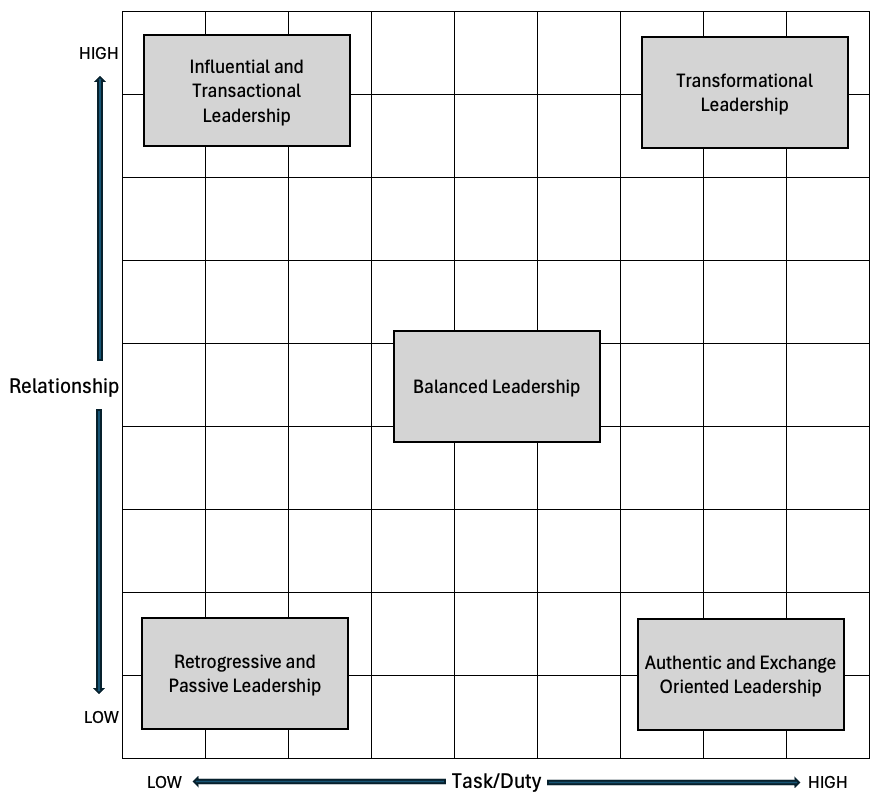
Note. Figure adapted from A systematic review of leadership styles in organizations: Introducing the concept of a task-relationship–change leadership network, by Dehghanan, H., Gheitarani, F., Rahimi, S., & Nawaser, K., 2021, International Journal of Innovation and Technology Management
Leaders must navigate a complex landscape shaped by the vast array of available theories and their varied outcomes. Amghar (2022), building on traditional contingency theories (Fiedler, 1964; Hersey, 1988; House, 1996; Kerr & Jermier, 1978; Yukl, 2013), emphasized the need for leaders to adapt the style of leadership to the special requirements of their environment. The variety of restraints, resources, opportunities, and objectives requires leaders within an organization to adjust their approach in order to optimize their effectiveness. Mirčetiċ et al. (2020) mirrored the approach of Dehghanan et al. (2021), stating that “Situational leadership models emphasize that the leader must adapt their style depending on the development level of their followers, balancing between task orientation and relationship orientation” (p. 95).
Leadership at the organizational level is at once both the sum of influenced individuals and the overarching movement of the organization towards the desired goal. Figure 2 illustrates the simultaneous influence of leaders and an example of a possible combination of leadership methods applied to each objective.
Figure 2
Variable leader influences throughout an organization.
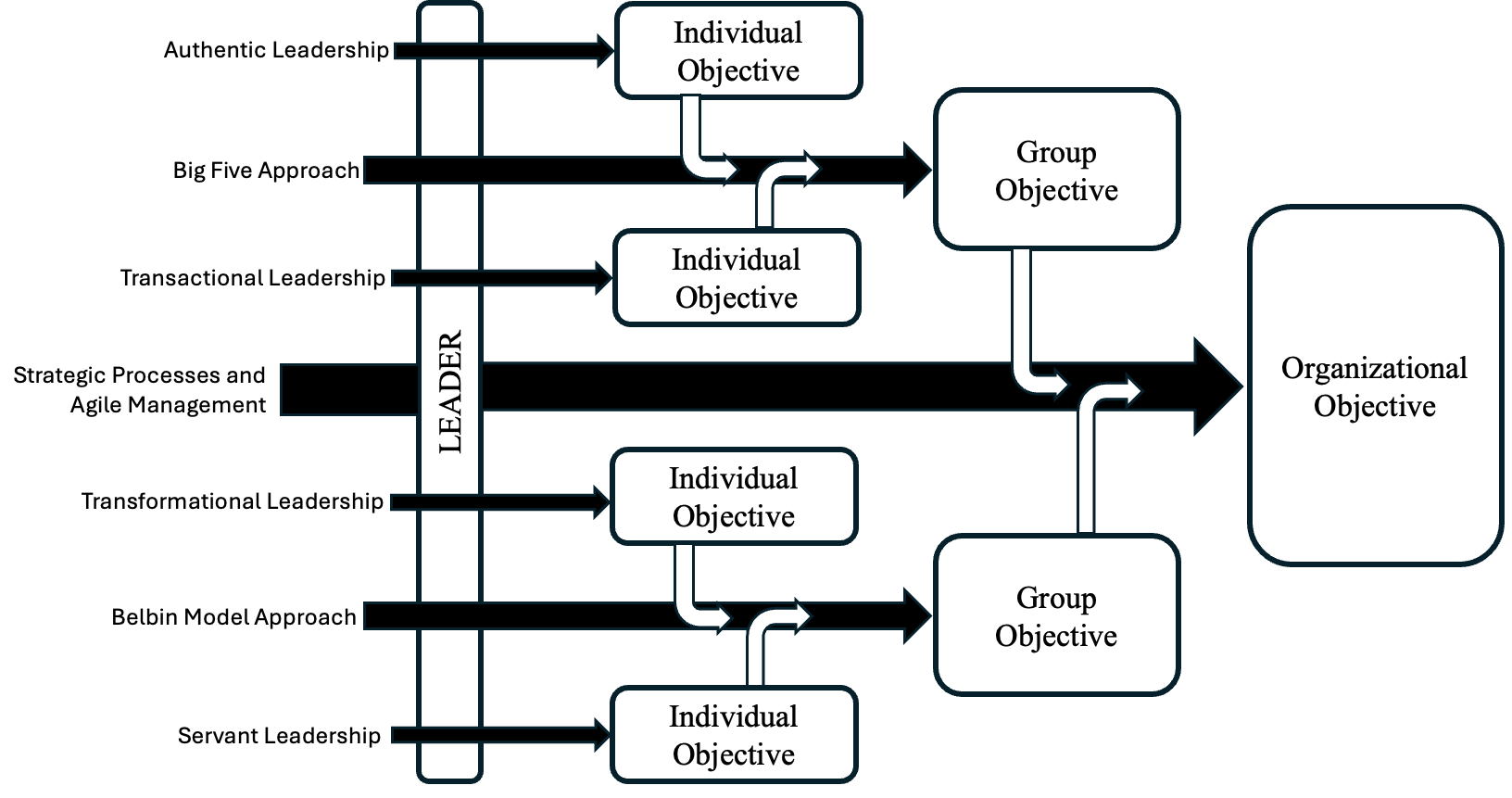
Note. The figure is an original creation by the author to demonstrate the hierarchical relationship of multi-level leadership influences.
Discussion
The necessity for a situational approach does not mean that models should be chosen at random or applied without constraint. Instead, it is imperative that the approaches applied by the leader maximize both their own strengths and those of their team. Because leadership styles have a significant influence on creating the organizational culture, which affects the satisfaction, motivation, and efficiency of employees (Enku & Dimovska, 2024), attention to tangential or collateral effects needs to be maintained.
The effect on culture, and in turn, the satisfaction, motivation, and efficiency of employees, cannot be ignored in a conversation about organizational leadership. Mykolayivna and Qiaolying (2024) noted that motivation theories like Maslow’s hierarchy of needs, Herzberg’s two-factor theory, Vroom’s expectancy theory, and Adams’ equity theory provide frameworks for understanding employee behavior, and that those theories need to be tailored to the needs of employees and the culture of the organization. Different leadership styles have different impacts on employee motivations (Sitthiwarongchai et al., 2020), and the choice of leadership methods must take into account both the impact on followers and on the culture of the organization.
Aside from employee motivations, other factors can be impacted by leadership methods applied throughout the organization. For example, transformational and democratic leadership positively affect innovation of employees (Costa et al., 2023), while a two-pronged approach—motivating (transformational) and capacity-building (empowering)—was found to be most effective for fostering innovation (Günzel-Jensen et al., 2018). Authentic leadership taps into psychological resources that create environments supportive of dialogue, learning, and participation (Alavi & Gill, 2017). As noted by Aksakal and Ucucan (2024), even generational differences, such as Gen Z employees, require a combination of approaches to meet their needs for collaborative, emotionally aware, and digitally savvy leadership.
Limitations and Future Research
There has been a historical precedence of the leader as the primary focus of leadership research, with followers and their behaviors studied only in the context of leader development (Matshoba-Ramuedzisi et al., 2022). Despite the historical emphasis on the leadership perspective, the role of followership must be addressed. Ribbit et al. (2024) noted that, since 2014 and Uhl-Bien’s (2014) casting the spotlight on the subject, there has been considerable work demonstrating how far followership can influence the leader, the leadership process, and organizational outcomes, alongside and beyond the leader’s influence. Arshad et al. (2022) highlighted the recurring theme of institutional and organizational success being linked to followership as well as leadership. While this research synthesis explores the complexity of multi-level leadership, future research should address “the other side of the leadership coin” (Ekundayo, 2010). Just as various leadership models can be applied at differing organizational levels, so too should the diversity of followership be explored.
An additional limitation of this research synthesis is the lack of empirical research on cross-level leadership effects. Future research should be aimed at identifying specific interactions of various leadership approaches and the trickle-down, or trickle-up effects that may be present between organizational levels. Similar studies targeting specific leadership theories and their trickle effects (Bormann & Diebig, 2021; Mayer et al., 2009; Stollberger et al., 2019) could serve as a model for future empirical research.
Conclusion
The vastness and complexity of organizational leadership can be daunting, leaving leaders questioning their effectiveness in the face of ever-evolving challenges. The good news is that leaders can position themselves to receive critical feedback as to the needs and expectations of followers. Dedahanov et al. (2022) found that benevolent and moral leadership styles positively affect trust and encourage employees to voice their needs and concerns. That, for leaders, seems to be a good place to start.
References
Abdillah, S. R., Yusriani, S., Patiro, S. P. S., Rekarti, E., & Amalia, A. (2024). Individual and group aspects in influencing organizational performance. Jurnal Bisnis Mahasiswa, 4(4), 642–651. https://doi.org/10.60036/jbm.v4i4.art15
Afrianty, T. W. (2020). Are leaders born or made?: A Point of View. Junal Peneliian Ipteks, 5(1), 17–23.
Aksakal, N. Y., & Ulucan, E. (2024). Revealing the leadership characteristics of the modern age: Generation-Z perspective. International Journal of Organizational Leadership, 13, 22–38. https://doi.org/10.33844/ijol.2024.60397
Alavi, S. B., & Gill, C. (2017). Leading change authentically: How authentic leaders influence follower responses to complex change. Journal of Leadership & Organizational Studies, 24(2), 157–171. https://doi.org/10.1177/1548051816664681
Amghar, A. (2022). Revisiting the contingency theories of leadership: Key features, meanings and lessons. Revue Marocaine de Gestion et de Société, 1, 76–93. https://www.researchgate.net/publication/365319421
Andersen, J. A. (2018). Servant leadership and transformational leadership: From comparisons to farewells. Leadership & Organization Development Journal, 39(6), 762–774. https://doi.org/10.1108/LODJ-01-2018-0053
Arshad, S. S., Zaman, S., & Nazir, A. (2022). Development and validation of scale for assessment of followership among school teachers. International Journal of Instruction, 15(3), 1031–1046. https://doi.org/10.29333/iji.2022.15355a
Bachiochi, P., O’Conner, M., Rogelberg, S., & Elder, A. (2000). The qualities of an effective team leader. Organizational Development Journal, 18(1), 11–27.
Balliet, D., & Van Lange, P. A. M. (2013). Trust, conflict, and cooperation: A meta-analysis. Psychological Bulletin, 139(5), 1090–1112. https://doi.org/10.1037/a0030939
Banks, G. C., McCauley, K. D., Gardner, W. L., & Guler, C. E. (2016). A meta-analytic review of authentic and transformational leadership: A test for redundancy. The Leadership Quarterly, 27(4), 634–652. https://doi.org/10.1016/j.leaqua.2016.02.006
Belbin, R. M. (1981). Management teams. John Wiley & Sons.
Belbin, R. M. (2017). Team Roles at Work. Routledge. https://doi.org/10.4324/9780080963242
Boerma, M., Coyle, E., Dietrich, M., Dintzer, M., Drayton, S., Early, J., Enginton, A., Horlen, C., Kirkwood, C., Lin, A., Rager, M., Shah-Manek, B., Welch, A., & Willians, N. (2017). Point/counterpoint: Are outstanding leaders born or made? American Journal of Pharmaceutical Education, 81(3), 1–5.
Bormann, K. C., & Diebig, M. (2021). Following an uneven lead: Trickle-down effects of differentiated transformational leadership. Journal of Management, 47(8), 2105–2134. https://doi.org/10.1177/0149206320931584
Bradley, J. H., & Hebert, F. J. (1997). The effect of personality type on team performance. Journal of Management Development, 16(5), 337–353. https://doi.org/10.1108/02621719710174525
Braun, S., & Peus, C. (2018). Crossover of work–life balance perceptions: Does authentic leadership matter? Journal of Business Ethics, 149(4), 875–893. https://doi.org/10.1007/s10551-016-3078-x
Bryant, S. E. (2003). The role of transformational and transactional leadership in creating, sharing and exploiting organizational knowledge. Journal of Leadership & Organizational Studies, 9(4), 32–44. https://doi.org/10.1177/107179190300900403
Burke, C. S., Stagl, K. C., Klein, C., Goodwin, G. F., Salas, E., & Halpin, S. M. (2006). What type of leadership behaviors are functional in teams? A meta-analysis. The Leadership Quarterly, 17(3), 288–307. https://doi.org/10.1016/j.leaqua.2006.02.007
Costa, J., Pádua, M., & Moreira, A. C. (2023). Leadership styles and innovation management: What Is the role of human capital? Administrative Sciences, 13(2), 47. Business Source Complete. https://doi.org/10.3390/admsci13020047
Dedahanov, A. T., Fayzullaev, A. K. U., Abdurazzakov, O. S., Rakhmonov, D. A., & Zakirova, O. (2022). Paternalistic leadership styles and employee voice: The roles of trust in supervisors and self-efficacy. Sustainability, 14(19). https://doi.org/10.3390/su141912805
Dehghanan, H., Gheitarani, F., Rahimi, S., & Nawaser, K. (2021). A systematic review of leadership styles in organizations: Introducing the concept of a task-relationship–change leadership network. International Journal of Innovation and Technology Management, 18(07). https://doi.org/10.1142/s021987702130007x
Dumitru, C. D., & Mittelstadt, A. (2020). What we know and what we do not know about trust in work teams: A systematic literature review. European Journal of Business and Management Research, 5(3). https://doi.org/10.24018/ejbmr.2020.5.3.303
Edmondson, A. (1999). Psychological safety and learning behavior in work teams. Administrative Science Quarterly, 44(2), 350–383. https://doi.org/10.2307/2666999
Ekundayo, J. (2010). Time to focus on Followers: Looking at the other side of the Leadership ‘coin.’ Academic Leadership: The Online Journal. https://doi.org/10.58809/gwig9219
Enku, I., & Dimovska, M. K. (2024). Leadership styles as a factor for successful management of human resources and economoc benefits in organizations. Visions, 43, 273–283. https://search.ebscohost.com/login.aspx?direct=true&AuthType=sso&db=a9h&AN=178141916&site=eds-live&scope=site&custid=seastcol&authtype=sso
Fiedler, F. (1964). Contingency model leadership effectiveness (L. Berkowitz, Ed.; pp. 150–188). Academic Press.
Goldberg, L. R. (1990). An alternative “description of personality”: The Big-Five factor structure. Journal of Personality and Social Psychology, 59(6), 1216–1229.
Greenleaf, R. K. (1977). Servant Leadership (25th Anniversary ed.). Paulist Press.
Günzel-Jensen, F., Hansen, J. R., Jakobsen, M. L. F., & Wulff, J. (2018). A two-pronged approach? Combined leadership styles and innovative behavior. International Journal of Public Administration, 41(12), 957–970. https://doi.org/10.1080/01900692.2017.1303711
Hakiki, M. S., Anggraini, D. A., Fahmi, N. F., Putra, R. S., & Adinugroho, M. (2023). Individual, group dynamics, and organizational processes in the workplace: Factors for better performance and organizational success. Journal on Education, 6(1), 3401–3430. https://doi.org/10.31004/joe.v6i1.3409
Halliwell, P. R., Mitchell, R. J., & Boyle, B. (2023). Leadership effectiveness through coaching: Authentic and change-oriented leadership. PloS One, 18(12). https://doi.org/10.1371/journal.pone.0294953
Hamstra, M. R. W., Van Yperen, N. W., Wisse, B., & Sassenberg, K. (2014). Transformational and transactional leadership and followers’ achievement goals. Journal of Business and Psychology, 29(3), 413–425. https://doi.org/10.1007/s10869-013-9322-9
Hersey, P. (1988). Management of organizational behavior (5th ed.). Prentice Hall.
House, R. J. (1996). Path goal theory leadership: Lessons, legacy, reformulated theory. Leadership Quarterly, 7(3), 323–352.
Jabeen, R., & Rahim, N. (2021). Exploring the effects of despotic leadership on employee engagement, employee trust and task performance. Management Science Letters, 11, 223–232. https://doi.org/10.5267/j.msl.2020.8.012
Judge, T. A., Bono, J. E., Ilies, R., & Gerhardt, M. W. (2002). Personality and leadership: A qualitative and quantitative review. The Journal of Applied Psychology, 87(4), 765–780. https://doi.org/10.1037/0021-9010.87.4.765
Kark, R., Shamir, B., & Chen, G. (2003). The two faces of transformational leadership: Empowerment and dependency. The Journal of Applied Psychology, 88(2), 246–255. https://doi.org/10.1037/0021-9010.88.2.246
Kellett, J. B., Humphrey, R. H., & Sleeth, R. G. (2006). Empathy and the emergence of task and relations leaders. The Leadership Quarterly, 17(2), 146–162. https://doi.org/10.1016/j.leaqua.2005.12.003
Kerr, S., & Jermier, J. (1978). Substitutes leadership: meaning measurement. Organizational Behavior Human Performance, 22(3), 375–403.
Klenke, K. (2007). Authentic leadership: A self, leader, and spiritual identity perspective. International Journal of Leadership Studies, 3(1), 68–97.
Korejan, M., & Shahbazi, H. (2016). An analysis of the transformational leadership theory. Journal of Fundamental and Applied Sciences, 8(3S), 452–461. https://doi.org/10.4314/JFAS.V8I3S.192
Lee, C., Yeh, W., Yu, Z., & Lin, X. (2023). The relationships between leader emotional intelligence, transformational leadership, and transactional leadership and job performance: A mediator model of trust. Heliyon, 9(8).
Matshoba-Ramuedzisi, T., de Jongh, D., & Fourie, W. (2022). Followership: a review of current and emerging research. Leadership & Organization Development Journal, 43(4), 653–668. https://doi.org/10.1108/lodj-10-2021-0473
Mayer, D. M., Kuenzi, M., Greenbaum, R., Bardes, M., & Salvador, R. (bombie). (2009). How low does ethical leadership flow? Test of a trickle-down model. Organizational Behavior and Human Decision Processes, 108(1), 1–13. https://doi.org/10.1016/j.obhdp.2008.04.002
Miller, D. (2003). The stages of group development – A retrospective study of dynamic team processes. Canadian Journal of Administrative Sciences / Revue Canadienne Des Sciences de l Administration, 20(2), 121–134.
Mirčetiċ, V., & Vukotić, S. (2020). The analysis of situational leadership models: origin, divergence and development. In D. Karabašević, S. Svetlana Vukotić, & G. Popović (Eds.), Innovation as an initiator of the development “innovations in the function of development” (pp. 93–113). Faculty of Applied Management, Economics and Finance.
Mumford, M., Marks, M., Connelly, M. S., Zaccaro, S., & Reiter-Palmon, R. (2000). Development of leadership skills: Experience and timing. The Leadership Quarterly, 11(1), 87–114.
Mumford, T. V., Campion, M. A., & Morgeson, F. P. (2007). The leadership skills strataplex: Leadership skill requirements across organizational levels. The Leadership Quarterly, 18(2), 154–166. https://doi.org/10.1016/j.leaqua.2007.01.005
Mykolayivna, P. I., & Qiaoying, L. (2024). Modern approaches for improving staff motivation. In M. L. Komarytskyy (Ed.), Science in the modern world: Innovations and challenges. Perfect Publishing. Special Link
Nanjundeswaraswamy, T. S., Nagesh, P., Bharath, S., & Vignesh, K. M. (2024). Leadership theories and styles—A systematic literature review and the narrative synthesis. Human Resources Management and Services, 6(3), 477–489. https://doi.org/10.18282/hrms.v6i3.3477
Northouse, P. G. (2021). Leadership: Theory and practice (9th ed.). SAGE Publications.
Owens, B. P., & Hekman, D. R. (2012). Modeling how to grow: An inductive examination of humble leader behaviors, contingencies, and outcomes. Academy of Management Journal, 55(4), 787–818. https://doi.org/10.5465/amj.2010.0441
Parolini, J., Patterson, K., & Winston, B. (2009). Distinguishing between transformational and servant leadership. Leadership & Organization Development Journal, 30(3), 274–291. https://doi.org/10.1108/01437730910949544
Raes, E., Kyndt, E., Decuyper, S., Van den Bossche, P., & Dochy, F. (2015). An exploratory study of group development and team learning. Human Resource Development Quarterly, 26(1), 5–30. https://doi.org/10.1002/hrdq.21201
Ribbat, M., Klasmeier, K. N., & Hüffmeier, J. (2024). Empirical followership research since the publication of the formal theory of followership by Uhl-Bien ET Al. (2014) — A systematic review. Collabra. Psychology, 10(1). https://doi.org/10.1525/collabra.92804
Salas, E., Sims, D., & Burke, C. S. (2005). Big five in teamwork. Small Group Research, 36(5), 555–599. https://doi.org/10.1177/1046496405277134SMALL
Shu, C.-Y. (2015). The impact of intrinsic motivation on the effectiveness of leadership style towards on work engagement. Contemporary Management Research, 11(4), 327–350. https://doi.org/10.7903/cmr.14043
Sitthiwarongchai, C., Wichayanuparp, W., Chantakit, P., & Charoenboon, P. (2020). Impact of organization’s leadership style on motivation of its employees. Systematic Reviews in Pharmacy, 11(3), 48–56. Academic Search Complete. https://search.ebscohost.com/login.aspx?direct=true&AuthType=sso&db=a9h&AN=144418861&site=eds-live&scope=site&custid=seastcol&authtype=sso
Stollberger, J., Las Heras, M., Rofcanin, Y., & Bosch, M. J. (2019). Serving followers and family? A trickle-down model of how servant leadership shapes employee work performance. Journal of Vocational Behavior, 112, 158–171. https://doi.org/10.1016/j.jvb.2019.02.003
Townend, A. (2010). Belbin team roles (pp. 111–117). https://doi.org/10.1057/9780230582019_11
Tuckman, B. W. (1965). Developmental sequence in small groups. Psychological Bulletin, 63(6), 384–399.
Tuckman, B. W., & Jensen, M. A. (1977). Stages of small-group development revisited. Group and Organizational Management, 2(4), 419–427.
Uhl-Bien, M., Riggio, R. E., Lowe, K. B., & Carsten, M. K. (2014). Followership theory: A review and research agenda. The Leadership Quarterly, 25(1), 83–104. https://doi.org/10.1016/j.leaqua.2013.11.007
Wheelan, S. A. (2009). Group size, group development, and group productivity. Small Group Research, 40(2), 247–262. https://doi.org/10.1177/1046496408328703
Wheelan, S. A., Davidson, B., & Tilin, F. (2003). Group development across time: Reality or illusion? Small Group Research, 34(2), 223–245. https://doi.org/10.1177/1046496403251608
Yukl, G. (2013). Leadership in organizations (8th ed.). Pearson Education